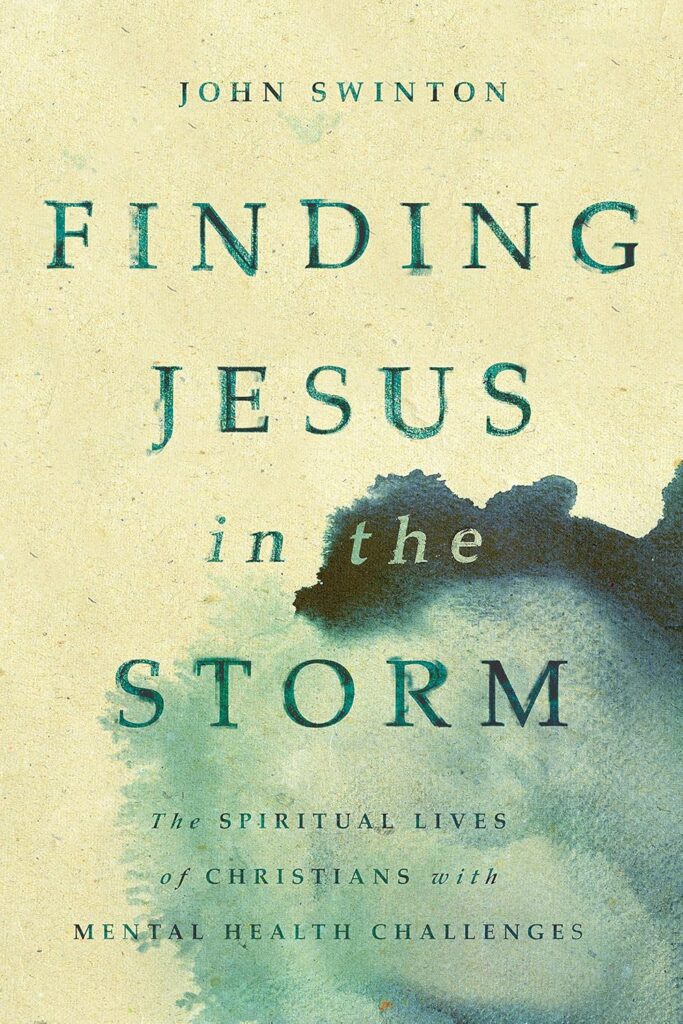
📚 Finding Jesus in the Storm: The Spiritual Lives of Christians with Mental Health Challenges — John Swinton (Eerdmans, 2020)
This sophisticated and sensitive book by a professor of practical theology and pastoral care at the University of Aberdeen is delivered in five parts. The first two parts interrogate the ways mental illnesses are described and diagnosed and offer a better way. Parts 3 to 5 respectively cover depression, schizophrenia and bipolar disorder.
“The core of the book emerges from a series of qualitative research interviews that I carried out over a two-year period with Christians living with major depression schizophrenia and bipolar disorder.” So the book is full of these first-hand accounts of Christians with the lived experience of mental illness. Then, throughout the author John Swinton offers some theological reflection and suggestions for revised practise. He prefers to speak about mental health challenges rather than “illness” and his book is not about curing. It is about healing, understood as the facilitation of understandings and circumstances in which people can live well with Jesus even when the prospect of a cure is beyond our current horizons.
Swinton talks about, for instance, connections between stigma and thin descriptions of mental illnesses. He also talks about the problem of the thinning of spirituality in relation to health care and the overall response to mental health challenges. Thick descriptions of mental health challenges are more helpful. Phenomenology provides a better way of founding a theological investigation “that takes seriously the various descriptions of mental health challenges that are available.”
Part 3 on depression begins with the story of a Christian man who took his own life, leaving some of his friends to fear for his eternal future. “I guess that is the problem with hyper-cognitive theologies that assume that our eternal futures lie in our own hands rather than in the loving hands of God. If it is the case that neither death nor life can separate us from God’s love, then we need not fear death, even death by suicide. We simply need to trust in God’s grace.” (pp. 71-72)
“Certain strands of theological thinking can be sucked into this hypercognitive trap when defining emphasis is placed on intellect and verbal ability, with the verbal proclamation of the name of Jesus assumed as a central and vital aspect of our salvation. When we think like this, any damage to the mind implicitly or explicitly morphs into damage to the soul.” (73)
There are three dimensions to the thinning of the language of depression: biological thinning, linguistic thinning, and spiritual thinning. We can thicken our understanding of depression by understanding what biblical joy is. Depression is antifeeling, not primarily about feeling sad. “Sadness is something that you know will pass. Depression is something you know will never pass.” Depression is an anti-feeling it makes it hard to find and keep joy.
“OK, for now it feels like Jesus has abandoned you. Jesus knows what it feels like to be abandoned. At this moment in time you don’t feel the way I feel, but I desperately want to help you hold on to the possibility that God exists, and the possibility that God loves you, and the possibility that joy might be closer than you think. I know that’s not how you feel, but it remains a possibility, and I want to hold that for you. But I want to sit with you in this darkness bracket (as best I can) and I want to say to you that I love you and that God loves you and that we can wait together. The storm will pass. Let me hold joy for you for a little while.” In chapter 5, called “Finding God in the darkness,” Swindon deploys Brueggemann’s typology of psalmic suffering to understand the experience of people with major depression.
“It feels something between numb and just raw pain, and ironically it’s like both can happen kind of at the same time. I’m completely numb and yet in real pain. And just everything is completely overwhelming, everything is very far off and distant and … at the most intense points it’s a kind of visceral experience of isolation. I remember being in a room with some of my closest friends and just being in real pain. I was screaming out inside, but no one could hear me. Feeling it physically, and yet not being able to express it, or if I did, it appeared to be quite incomprehensible.”
Swinton even mentions Richard Baxter’s advice that sometimes it is not good for a depressed person to engage in deep meditation on the Bible.
Swindon introduces a 42-year-old man named Robert who experiences double depression. Robert says, “For me in another way faith became a trap because I knew suicide was wrong and I knew my Bible and I knew Jesus love me. I knew that he died for me, but it was like a trap because all I wanted was to die. I knew the consequences of taking your own life from a biblical perspective. That’s my belief system! You know so basically I’d be going against my own belief system. In my belief system the consequence of suicide would be damnation, I suppose. Hell. I know that sounds very old fashioned. You shouldn’t take your own life, it’s up to God when you’re going to die, is my belief. So I’m trapped into life. I’m trapped! What do I do? You know if I go that way I end up in hell, and yet at the same time, I’m actually living in hell! One is permanent, the other is eternal. So what do you do? You try and keep living.”